ARCLIGHT

Search Arclight

Find services, research, and practical tools.

Popular topics

    Services

    AI Implementation & Assurance

    AI adoption roadmaps, workflow automation, responsible implementation and independent system assessment, with focused support for healthcare and public-sector organizations.

    Many small practices see the potential in AI but lack a dedicated team to turn scattered experiments into a reliable operating workflow. Arclight helps identify where the work is repetitive, where judgment must stay with staff, and what can be implemented safely and usefully.

    Our experience includes administering and deploying ChatGPT Enterprise for healthcare use, configuring workspace access and controls, and building agent-assisted workflows. We can support general business automation as well as healthcare-specific implementation, from a first pilot through staff training and ongoing refinement.

    Start with the business priority, then build a sequenced AI adoption roadmap. We help prioritize use cases, define measurable value, establish governance and an operating model, and assign ownership and sponsor responsibilities. Pilot evidence informs what to expand, change, or stop as workflows move from design through deployment.

    OpenAI Academy AI Leadership badge earned by Lance McNeill

    Professional development

    OpenAI Academy · AI Leadership

    Lance McNeill completed OpenAI Academy's AI Leadership course. The course covers aligning AI adoption with business priorities, sequencing a roadmap, assigning governance and ownership, and using evidence to guide deployment and expansion.

    • AI roadmap prioritization
    • Evidence-backed AI value articulation
    • AI governance and operating model design
    • AI adoption planning and change leadership
    • Responsible AI solution design and deployment

    Issued October 6, 2026 · Credential expires April 6, 2027
    Wound-care documentation services

    Wound-Care EMR Templates & Documentation Optimization

    For wound-care documentation inside your EMR, template development is led by an advanced practice provider: a clinical nurse specialist with years of experience in wound care. Work with your vendor on template content, conditional fields, reassessment prompts, and carry-forward controls.

    Explore EMR Template Services

    Audience

    • Independent healthcare practices
    • Specialty clinics and provider groups
    • Practice administrators
    • Clinical operations teams
    • Organizations starting or expanding AI use

    From use case to working practice

    • AI roadmap prioritization and workflow discovery
    • Evidence-backed AI value articulation and success measures
    • AI governance and operating model design
    • Platform selection and workspace administration
    • Role-based access and data-handling design
    • Agent-assisted and repeatable task automation
    • Human review, escalation, and quality checks
    • AI adoption planning, change leadership, and staff training
    • Stakeholder alignment, governance specifications and pilot evaluation
    • AI Assurance assessments

    Where implementation can help

    Practice Operations

    Map high-friction administrative work and pilot tools for drafting, organizing, routing, and checking routine materials.

    Healthcare Documentation Workflows

    Design clinician-reviewed assistance for patient communications, referral and authorization drafts, policy lookup, and documentation preparation.

    Workspace & Agent Deployment

    Configure eligible enterprise workspaces, permissions, approved tools, reusable instructions, and bounded agents around the practice's actual workflow.

    Governance & Training

    Establish an AI operating model with sponsors, workflow owners, approved uses, review responsibilities, escalation paths, and staff training before broader adoption.

    What an engagement can deliver

    • Sequenced AI adoption roadmap and prioritized workflow map
    • Business-value measures and pilot evaluation criteria
    • Governance, ownership, and sponsor responsibilities
    • Configuration and access-control plan
    • Pilot workflow or agent with human checkpoints
    • Testing criteria and observed results
    • Staff instructions and training
    • Rollout and improvement roadmap

    A practical rollout

    01

    Find the right workflow

    Prioritize a specific workflow around business value. Map its source data, users, exceptions, and current review process, then define success measures.

    02

    Set the safeguards

    Assign workflow ownership and sponsorship. Confirm applicable agreements, approved features, permissions, data boundaries, and human decision points.

    03

    Build and test

    Configure a limited pilot, test real-world edge cases, and measure usefulness and error modes before expansion.

    04

    Train and improve

    Train the team and review observed performance against the success measures. Use that evidence to decide what to expand, change, or stop.

    AI Assurance

    Independent assessment of high-stakes AI systems for objective alignment, transparency, human review, appeal pathways, access, burden, and accountability.

    Implementation includes testing the workflows we help build. Independent AI Assurance is a separate assessment engagement focused on the system's governance, evidence and effects on people.

    Assurance dimensions

    • Objective and incentive alignment

    • AI governance, operating model, and ownership clarity

    • Stakeholder participation

    • Human review and appeal pathways

    • Rationale transparency and documentation

    • Accuracy, access, and burden metrics

    • Independent oversight and public reporting

    Outputs

    • AI Assurance assessment
    • High-level grade or rating
    • Explanatory findings
    • Recommended corrective actions
    • Optional briefing

    Framework in development. Methodology and rating scale will be published separately.

    Implementation case study

    What the CMS WISeR AI rollout shows about readiness

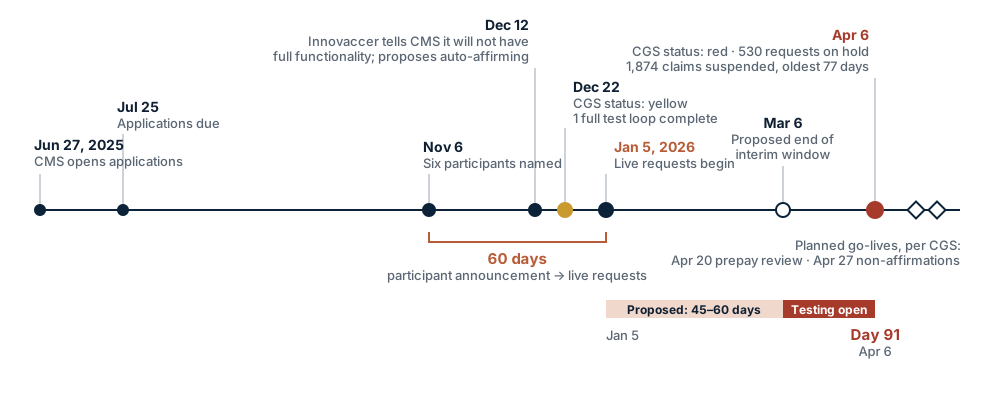
    WISeR is a Medicare model launched in six states that uses AI technology together with the clinician review to assess selected services before payment. Six participating companies were named in November 2025. Live requests began 60 days later, while records from Ohio showed unfinished end-to-end testing.

    By April, Ohio's Medicare contractor reported requests on hold and claims suspended. The timeline below follows the rollout from participant selection through those reported backlogs. It illustrates why a pilot needs tested handoffs, a correction path, and a way to pause before expansion.

    1. June 27, 2025CMS opens applications
    2. July 25Applications due
    3. November 6Six participants named
    4. December 12Innovaccer warns CMS it will not have full functionality at go-live and proposes an interim auto-affirming period
    5. December 22CGS marks Ohio implementation yellow; one full prior-authorization test loop completed
    6. January 5, 2026Live requests begin, 60 days after participant announcement
    7. Early MarchThe proposed 45-to-60-day interim window would have ended
    8. April 6, day 91CGS marks Ohio red: 530 requests on hold and 1,874 claims suspended; the oldest suspended claim was 77 days old
    9. April 20 and 27CGS lists planned dates for prepayment review and prior-authorization non-affirmations
    Figure 1. WISeR rollout milestones and Ohio implementation status. Innovaccer proposed a 45-to-60-day auto-affirming period; the reviewed records do not establish how long it actually operated. April counts are a CGS operating snapshot, not a count of unique patients. Sources: CMS WISeR model and CMS records released by EFF, PDF pp. 200–201, 216–218, 220–221.
    Read the WISeR Case Study

    PHI use is scoped only after confirming applicable business associate agreements, HIPAA-eligible products and features, practice policies, minimum-necessary access, retention, and human oversight. No platform or configuration alone guarantees HIPAA compliance.

    AI Implementation & Assurance

    AI adoption roadmaps, workflow automation, responsible implementation and independent system assessment, with focused support for healthcare and public-sector organizations.